Chapter 23: Social Responsibility and the Social License to Operate#
Chapter Note
This chapter addresses the relationship between the oil and gas industry and the communities, regulators, and public that shape its ability to operate. It is intentionally different from the technical chapters that precede it: there are no equations to solve, no design factors to apply. Instead, the chapter presents case studies, asks uncomfortable questions, and argues that the future of the drilling profession depends as much on engineers’ judgment and integrity as on their technical skill.
Learning Objectives#
By the end of this chapter, you should be able to:
Define “social license to operate” (SLO) and explain why it matters independently of legal compliance.
Describe how the regulatory landscape for oil and gas operations is structured across federal, state, and local levels, and identify where gaps exist.
Apply a structured liability analysis to a real incident involving legacy well infrastructure, identifying the competing claims of different responsible parties and the tensions between legal assignment of responsibility and practical equity.
Explain the paradox of mitigation: how well-intentioned engineering responses to community concerns can, if poorly communicated, deepen rather than repair community trust.
Describe the regulatory changes triggered by major drilling accidents and explain how industry-wide SLO was affected.
Articulate the professional engineer’s responsibilities under applicable codes of ethics with respect to public safety and transparency.
23.2 The Regulatory Framework — and Its Gaps#
Drilling is regulated at multiple levels, and understanding who regulates what, and where the gaps lie, is essential for understanding how incidents occur and who bears responsibility.
23.2.1 Federal Regulation#
The U.S. Environmental Protection Agency (EPA) has primary jurisdiction over environmental protection under statutes including the Clean Air Act (emissions), the Clean Water Act (surface water protection), and the Safe Drinking Water Act (underground injection control under the UIC program). The UIC program specifically governs saltwater disposal wells, injection for enhanced recovery, and carbon sequestration.
The Bureau of Safety and Environmental Enforcement (BSEE) regulates offshore drilling on the Outer Continental Shelf. BSEE was created in 2011 in the wake of the Deepwater Horizon disaster (Section 23.5), separating the safety and enforcement functions from the leasing and revenue functions that had been combined in the former Minerals Management Service.
The Pipeline and Hazardous Materials Safety Administration (PHMSA) regulates interstate pipelines.
23.2.2 State Regulation#
Most onshore drilling in the United States is regulated at the state level. The Texas Railroad Commission (RRC) regulates oil and gas drilling, production, and abandonment in Texas — including saltwater disposal wells. The Colorado Oil and Gas Conservation Commission (COGCC) performs a similar role in Colorado. Each state regulator sets its own standards for well construction, cementing, abandonment, and setback distances from homes, schools, and water sources.
State regulation creates substantial variation. A well abandonment standard that was adequate in Texas in 1957 is evaluated by today’s standards when something goes wrong in 2022.
23.2.4 Regulatory Gaps and Legacy Liabilities#
The regulatory framework was built incrementally over decades, responding to problems as they arose. This means:
Wells abandoned before modern plug-and-abandonment standards were developed may have inadequate cement plugs by today’s criteria.
Underground injection operations approved under one regulatory regime may have unforeseen interactions with legacy wells approved under a different regime.
When a company is acquired, the acquiring company inherits the liability for all legacy wells, including wells drilled by predecessor companies that may have operated under entirely different standards.
When no active company can be identified as responsible — a condition known as an orphan well: the state typically bears the cost of remediation.
There are estimated to be hundreds of thousands of orphan wells across the United States, representing a multi-billion-dollar remediation liability that falls to taxpayers when the responsible industry parties no longer exist.
23.3 Case Study: The Crane County Geyser — Legacy Wells and Shifting Subsurface Use#
23.3.1 What Happened#
On New Year’s Eve 2021, a hundred-foot column of briny salt water began erupting from a cattle ranch in Crane County, Texas, approximately 35 miles southwest of Odessa. The geyser shot skyward with a dull roar, discharging an estimated 25,000 barrels of water per day and turning the surrounding landscape white with salt and minerals. It was visible from miles away across the flat Permian Basin terrain.
No well appeared in the Railroad Commission’s active database at the eruption location. Investigators digging through state archives eventually found the source: a 1,390-foot dry hole drilled by Gulf Oil in 1948. The well had been plugged and abandoned in 1957 — properly, under the standards of the time — and then forgotten. Gulf Oil was acquired by Chevron in 1984. Because Chevron inherited Gulf’s entire legacy well portfolio through that merger, the Railroad Commission turned over command of the blowout to Chevron. A Chevron spokesperson acknowledged: “We are committed to assuming full responsibility for onsite operations, remediation and costs.”
The well had not simply degraded and failed. Something had pressurized the formation above the old cement plugs. The most likely explanation: the enormous volume of saltwater disposal (SWD) operations in the Permian Basin — where highly saline water produced alongside oil and gas is injected back underground at high pressure — had migrated into the formation and built up pressure over decades until it found a weak point. The old, deteriorating cement plugs in the 1948 well provided that weak point.
Related Problem: Lake Boehmer
Only twelve miles northeast of the Crane County geyser lies Lake Boehmer — sixty acres of noxious, briny water flowing from what began as an oil well but was converted decades ago to a water well. Unlike the Chevron geyser, Lake Boehmer has no clear responsible party: it falls between jurisdictions, with neither the Railroad Commission (oil and gas wells) nor the state water authorities (water wells) claiming ownership of the problem. It has been growing for twenty years. Nobody has been required to fix it.
Stopping the geyser was itself technically complex: simply capping the well above ground could redirect the pressurized flow underground, potentially sending salt water into a freshwater aquifer. Investigators debated whether the vacuum trucks capturing the erupted water and reinjecting it into a nearby SWD well were making the underlying pressure problem worse. The underground rock of West Texas, said one hydrogeologist, was “like Swiss cheese” — thousands of old wells, many deteriorating, and a subsurface pressure field shaped by a century of oil, gas, and water extraction and injection.
Sarah Stogner, a petroleum attorney representing a nearby landowner with a similar zombie-well problem, described the likely future: “There is no way to control it. We can only manage it. It is going to be a game of whack-a-mole.”
23.3.2 Discussion Activity: Who Is Liable?#
Class Discussion
Read: Russell Gold, “A Forgotten Oil Well Births a 100-Foot Geyser in West Texas,” Texas Monthly, January 12, 2022. (https://www.texasmonthly.com/news-politics/west-texas-geyser-oil-well-chevron/)
The question: The law says Chevron is responsible — and Chevron accepted that responsibility. But consider the following parties and their roles:
Chevron: Inherited the liability by acquiring Gulf Oil in 1984. Had no knowledge the well existed; it did not appear in the active Railroad Commission database. The well was properly abandoned in 1957 under the standards of the time.
The operator of nearby saltwater disposal wells: The SWD operations that likely created the overpressurized formation were conducted legally, under active permits, by operators who are not the party bearing the cleanup cost.
The landowner: The ranch where the geyser appeared. Did not drill the well, did not operate SWD, suffered the most direct property damage.
The Texas Railroad Commission: The state regulator that permitted both the original well abandonment and the SWD operations. Did not maintain records adequate to identify the well in its active database.
The State of Texas / Federal government: Set the regulatory frameworks under which all parties operated. Congress and the Texas Legislature have made repeated decisions not to fund proactive orphan well remediation.
Discuss:
Is the legal assignment of liability to Chevron the morally correct outcome? If yes, why? If no, who else should bear some portion of the cost, and how would you apportion it?
The SWD operators who pressurized the formation did so legally, under active permits. Does legal compliance absolve them of responsibility for foreseeable consequences?
What regulatory changes would you recommend to prevent this problem in the future? Who should pay for them?
The well was “properly abandoned” in 1957. How should society handle the fact that “proper” changes over time — and that the subsurface uses surrounding a plugged well will continue to change for decades or centuries after abandonment?
23.4 Case Study: Noise, Visibility, and the Paradox of Mitigation#
23.4.1 Noise as a Community Issue#
Drilling operations generate significant noise. Diesel engines on drawworks and mud pumps, iron roughneck and tong operations, truck traffic for cuttings disposal and supply deliveries, flare ignition — all of these contribute to a noise environment that can be intrusive to residents within a mile or more of an active location.
In Colorado, community opposition to oil and gas development near residential areas, schools, and parks intensified through the 2010s as the Denver-Julesburg Basin (DJ Basin, primarily Weld County) was developed with dense pad drilling operations close to rapidly growing suburban communities. Noise was among the most frequent community complaints, alongside concerns about air quality, truck traffic, and property values.
The industry and state regulator responded in part with requirements for noise abatement walls — large barriers erected around drill sites to reduce sound transmission to surrounding neighborhoods. From a pure noise-reduction standpoint, these walls worked: they measurably reduced sound levels at neighboring properties.
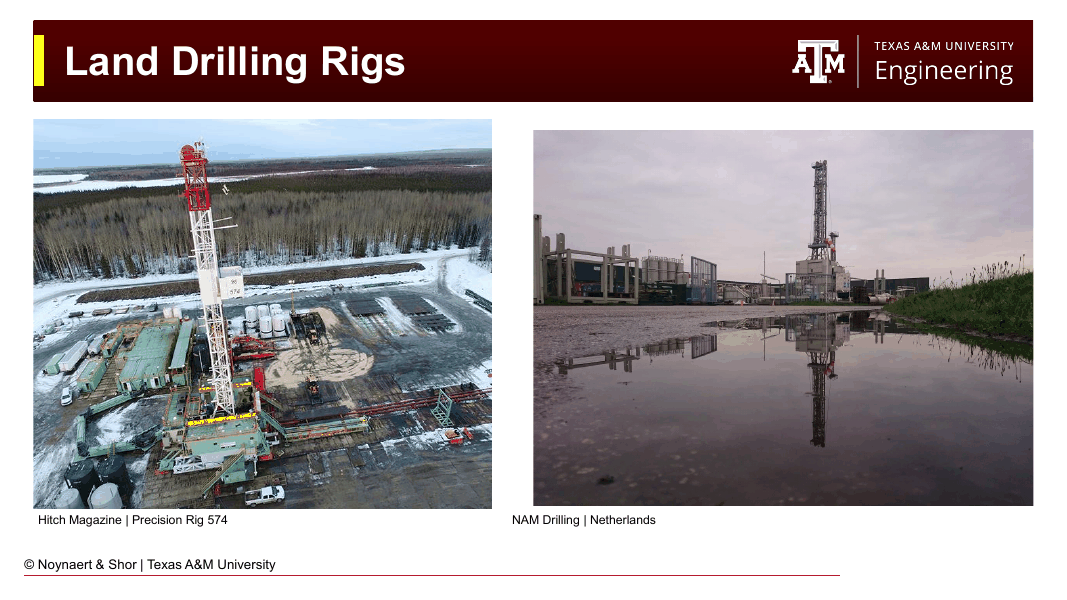
Fig. 270 Two land rigs, two communities (from Chapter 3): in remote northern Alberta (left) the nearest neighbor is forest; in the Netherlands (right) the rig drills beside a town from behind a full sound wall — the mitigation at the center of this section’s paradox.#
23.4.2 The Paradox#
The walls created a new problem: they made operations invisible.
Residents who had been able to see what was happening at the drill site — the rig, the flares, the truck traffic, the personnel — now saw only a wall. For communities that already had limited trust in the industry, the walls read not as a neighborly noise reduction measure but as a deliberate effort to conceal operations. Suspicions about air quality, about spills, about what was being done behind the barrier increased rather than decreased.
This is a well-documented phenomenon in risk communication: technical mitigation without communication can deepen rather than repair trust deficits. A company that installs noise walls without explanation tells the community implicitly that operations are something to be hidden. A company that installs noise walls with transparent explanation — public meetings, real-time air quality monitoring displays visible to the community, regular updates — has a chance to convert the mitigation from a source of suspicion into a demonstration of good faith.
Class Discussion
Read: “Noise complaints mount against oil and gas industry,” Denver Post, August 20, 2017.
Discuss:
The industry made a genuine engineering investment to reduce noise impacts. Why did this make some residents more suspicious rather than less?
What could operators have done differently in implementing noise abatement to build trust rather than suspicion?
Is transparency always the right answer? Are there situations where operational confidentiality is legitimate, and how should companies communicate those limits to communities?
Colorado’s setback regulations have been a major political battleground, with industry, environmental groups, and local governments all advocating for different rules. What factors should determine the appropriate setback distance from a residential area?
23.4.3 Light, Odor, and Traffic#
Noise is one of many community impact vectors from drilling operations. Others include:
Light pollution: Modern drilling rigs operate 24 hours a day. The light from a rig and associated equipment — particularly flares — is visible for miles in the low-population rural areas where most drilling occurs. In areas near suburban and exurban communities, light intrusion is a significant quality-of-life concern.
Odor and air quality: Volatile organic compounds (VOCs) from produced fluids, diesel combustion from engines, and hydrogen sulfide in sour gas formations create odor complaints and legitimate air quality concerns. Many states now require continuous air quality monitoring at drill sites near populated areas.
Truck traffic: Drilling a single well requires hundreds of truck trips — for water, chemicals, casing, cement, and cuttings disposal. In communities with limited road infrastructure, this traffic is often the most visible and most disruptive impact. Road damage and safety incidents involving heavy trucks near schools and residential areas are common sources of community grievance.
Each of these impacts has technical mitigation options. Electric rigs powered by grid electricity eliminate diesel noise and emissions. Closed-loop mud systems eliminate road trips for drill cuttings. Buried or barged water supply eliminates water truck traffic. Pipeline saltwater disposal eliminates SWD truck traffic. The business case for these investments is rarely driven by cost savings alone — it requires a company to value the social license benefits of reduced community impact.
23.5 Case Study (Placeholder): Deepwater Horizon and the Failure of Well Control#
Placeholder — Content to Be Developed
This section will be developed with full case study content. The following outline indicates the key topics to be covered.
What happened (April 20, 2010):
Macondo well blowout on the Deepwater Horizon semi-submersible drilling rig
Explosive blowout and fire; 11 workers killed; rig sank
87-day discharge: approximately 4.9 million barrels of oil released into the Gulf of Mexico
Largest accidental marine oil spill in history
Technical failures:
Well control decision-making: negative pressure test misinterpretation (the “bladder effect”)
Temporary abandonment procedures: removal of drill pipe mud before setting cement plug
Cementing: use of nitrogen-foamed cement with inadequate laboratory verification
BOP: dual-ram blind shear ram design did not reliably sever pipe; automatic mode function (AMF) batteries depleted
Command and control: confusion among Transocean (drilling contractor), BP (operator), and Halliburton (cementer) about who had authority to act
Regulatory failures:
The Minerals Management Service combined leasing (revenue) functions with safety enforcement, creating a structural conflict of interest
Categorical exclusions from environmental review were routinely granted for deepwater operations without meaningful risk assessment
BSEE created post-Macondo with explicit mandate to separate safety from revenue functions
The Social License Impact:
Six-month offshore drilling moratorium; economic devastation to Gulf Coast service industry
Multi-year criminal investigation; BP pled guilty to 14 criminal charges; $4.5 billion in fines
Billions in civil penalties under the Clean Water Act; total legal liability exceeded $65 billion
Deepwater drilling operations in many parts of the world were frozen pending investigation
Public polling showed sharp decline in support for offshore drilling nationally
Key questions for discussion:
Multiple parties (BP, Transocean, Halliburton) were found to share blame. How should liability be allocated among parties with different roles and different levels of information?
The negative pressure test showed anomalous results that were misinterpreted. What systems or procedures could have caught this?
A moratorium was imposed across the entire offshore industry for actions taken by one company on one well. Was this an appropriate regulatory response?
The accident was classified as “unforeseeable” by some parties. Is a risk that was never specifically anticipated truly unforeseeable, if the component failure modes were individually known?
Key references:
National Commission on the BP Deepwater Horizon Oil Spill and Offshore Drilling, Deep Water: The Gulf Oil Disaster and the Future of Offshore Drilling (January 2011)
U.S. Chemical Safety and Hazard Investigation Board, Investigation Report: Macondo Blowout and Explosion (2016)
Graham, B. et al. (Presidential Commission), Report to the President, January 2011
23.6 Case Study (Placeholder): Induced Seismicity and Saltwater Disposal#
Placeholder — Content to Be Developed
This section will be developed with full case study content. The following outline indicates the key topics to be covered.
The phenomenon:
Oklahoma earthquake rate surged from a historic background of ~1.5 magnitude-3+ earthquakes per year to more than 900 in 2015 — a 600× increase attributable to high-volume saltwater disposal injection
Similar (smaller scale) increases observed in Texas (around Midland), Kansas, Colorado, and other producing states
Induced seismicity is mechanistically distinct from hydraulic fracturing; it is primarily driven by long-term pressure changes in deep disposal formations, not by the fracturing operation itself
The liability problem:
Causation in induced seismicity is probabilistic and distributed: any single injection well contributes a small fraction of the total pressure change; no single well can be identified as the sole cause of a specific earthquake
Damage claims (structural damage to homes and businesses) have been filed; courts have struggled with how to assign responsibility when no single defendant caused the harm
Oklahoma has implemented traffic-light protocols: injection must be curtailed or stopped if seismicity exceeds defined thresholds near an injection well
The Crane County connection:
The same regional pressure buildup from SWD operations in the Permian Basin that is suspected in the Crane County geyser event (Section 23.3) was linked by USGS to increased earthquake frequency around Midland in the same period
Key questions for discussion:
How should liability be assigned when harm is caused by the aggregate effect of many individually permitted actions, each of which would be harmless in isolation?
Traffic-light protocols (reduce injection when earthquakes occur nearby) are a precautionary response. At what level of seismic risk should operations be curtailed? Who decides?
Saltwater disposal is a byproduct of oil and gas production that has no cost-effective alternative at scale. If SWD is restricted, what happens to the produced water?
23.7 Case Study (Placeholder): Hydraulic Fracturing, Water, and Public Perception#
Placeholder — Content to Be Developed
This section will be developed with full case study content. The following outline indicates the key topics to be covered.
The public concern:
Hydraulic fracturing uses large volumes of water (2–10 million gallons per well, depending on lateral length and formation)
Public concerns focus on: (1) groundwater contamination from fracturing fluid or returned produced water, (2) competition for water resources in arid regions, (3) surface spills of produced water or fracking fluid, and (4) disposal of produced water via SWD (see induced seismicity)
The science vs. the perception:
EPA’s comprehensive 2016 review found that hydraulic fracturing activities “can impact drinking water resources under some circumstances,” but documented cases of direct aquifer contamination from fracturing operations (as opposed to surface spills or well casing integrity failures) are rare
The gap between documented scientific risk and public perceived risk is large; this gap itself is a social license challenge
The role of the documentary film Gasland (2010) and its iconic “flaming tap water” sequence in shaping public perception
Regulatory responses:
State-level chemical disclosure requirements (FracFocus database): operators must report all fracturing fluid chemicals
Baseline water testing requirements before fracturing
Casing integrity requirements
Colorado: 2,000-foot setback from occupied structures enacted via Proposition 112 (2018 ballot measure, failed) and SB 181 (2019, passed)
Key questions for discussion:
How should the industry communicate about a risk that is small but not zero, in a media environment that rewards dramatic narrative over statistical literacy?
Is mandatory chemical disclosure sufficient to address legitimate public concerns, or does it only give the appearance of transparency?
Setback regulations affect which acreage can be economically developed. How should the trade-off between community impact and resource development be made — and by whom?
23.8 The Engineer’s Professional Responsibility#
23.8.1 Codes of Ethics#
Professional engineers in the United States are bound by the NSPE (National Society of Professional Engineers) Code of Ethics, which states in its fundamental canon that engineers must “hold paramount the safety, health, and welfare of the public.” Similar language appears in the SPE (Society of Petroleum Engineers) Code of Ethics, which requires members to “be truthful in professional matters” and to “apply their knowledge and skill for the advancement of human welfare.”
These are not abstractions. They have direct implications for the situations described in this chapter:
An engineer who interprets an anomalous pressure test result and concludes that everything is fine — when it is not — has failed in their professional duty, regardless of organizational pressure to continue operations.
An engineer who selects a saltwater disposal formation without investigating the legacy well inventory in the area has failed to apply due diligence proportionate to the foreseeable consequences.
An engineer who knows about a problem — a failing cement plug, an anomalous pressure reading, an undisclosed incident — and does not report it has violated both professional ethics and, in many cases, law.
23.8.2 The Duty to Speak#
Engineering ethics codes consistently recognize a duty to speak — to raise concerns through appropriate channels even when doing so is uncomfortable or professionally risky. The National Commission investigating the Deepwater Horizon accident found that “whether purposeful or not, many of the decisions that BP, Halliburton, and Transocean made that increased the risk of the Macondo blowout clearly saved those companies significant time and money.” Individual engineers at multiple companies had concerns and did not raise them effectively.
The duty to speak does not require heroism. It requires:
Documenting concerns in writing.
Raising concerns through the proper chain of command.
Escalating when normal channels fail.
Knowing what whistleblower protections exist (federal law provides significant protection for oil and gas workers who report safety violations to OSHA).
23.9 Stakeholder Engagement#
23.9.1 Who Are the Stakeholders?#
In oil and gas operations, stakeholders include:
Landowners: Often have mineral or surface rights issues; affected by noise, traffic, and visual impact.
Local communities: Residents within visible or audible range of operations; affected by air quality, traffic, and property values.
Local governments: Counties and municipalities that receive (or do not receive) tax revenue; responsible for road maintenance; often caught between industry and community pressure.
State regulators: Set the rules; responsible for enforcement; subject to political pressure from both industry and environmental advocates.
Environmental organizations: Range from technically sophisticated policy advocates to grassroots community groups to national campaigns; vary enormously in their goals and good faith.
Tribal governments (First Nations in Canada): In many parts of the West, oil and gas operations occur on or near tribal lands with complex jurisdictional histories.
Investors and financial institutions: Increasingly imposing ESG (Environmental, Social, and Governance) requirements; a company’s social license record affects its access to capital.
23.9.2 Principles of Effective Engagement#
Effective stakeholder engagement is not public relations. It shares several features:
Early and genuine: Engagement that begins before operations have been planned — when community input can actually shape design decisions — is fundamentally different from engagement that begins after decisions have been made and seeks to inform or persuade. Communities can tell the difference.
Transparent about uncertainty: The worst outcomes in community relations typically follow a company’s claim that an operation is perfectly safe, followed by an incident that demonstrates it was not. Honest communication about what is known, what is uncertain, and what the company will do if something goes wrong is more credible and more durable than assurances of zero risk.
Consistent: Trust is built over years and destroyed in hours. A company that has operated responsibly for a decade, communicates proactively, and has a strong local employment record will survive an incident that would destroy a company with no relationship capital.
Two-way: Listening to community concerns and demonstrating that they have influenced operational decisions — not just acknowledging them — is the difference between consultation and genuine engagement.
Chapter Summary#
Social license to operate is the informal but essential complement to formal regulatory approval. It is earned by behavior, lost by incident or broken trust, and rebuilt only slowly and at significant cost. The incidents described in this chapter — a forgotten well in West Texas, noise walls in Colorado suburbs, a deepwater blowout in the Gulf of Mexico, earthquake swarms in Oklahoma — are not aberrations. They are predictable consequences of operating a complex, high-energy industry in an increasingly populated world with an increasingly connected and informed public.
The engineering profession has a distinctive role in shaping these outcomes. Engineers design the wells, select the formations, write the procedures, and make the on-the-ground decisions that determine whether operations are safe, whether communities are impacted, and whether incidents occur. The technical chapters of this textbook equip you to do those things correctly. This chapter asks you to also think about what “correctly” means — not just whether the design meets code, but whether it meets the test of being something you can explain to the people who live above the well.
The most important engineering skill for social license is not a technical one. It is the ability to ask, honestly and before something goes wrong: what could go wrong, who would be affected, and would I be comfortable defending this decision if it did?
Key Terms#
Social license to operate (SLO): The ongoing acceptance and approval by communities and stakeholders of a company’s operations, independent of formal legal permits.
Orphan well: An abandoned well with no identifiable responsible party; remediation falls to the state or federal government.
Zombie well: Informal term for a plugged and abandoned well that returns to activity due to subsurface pressure changes.
Induced seismicity: Earthquakes triggered by human subsurface activities, most commonly high-volume saltwater disposal injection.
Risk communication: The practice of communicating about risks — their nature, magnitude, and management — to non-technical audiences in ways that are accurate, honest, and comprehensible.
Whistleblower: A person who reports misconduct, safety violations, or other wrongdoing, typically within their organization; protected by federal law in many circumstances.
Practice Problems#
23.1. A saltwater disposal well operator injects produced water into a formation at 8,500 ft. Two years after injection begins, a plugged and abandoned well from 1962 — owned by a company that no longer exists — begins leaking briny water into a shallow freshwater aquifer 3 miles away.
(a) Who are the potential liable parties in this scenario? List at least four.
(b) The SWD operator operated legally and under an active UIC permit at all times. Does legal compliance extinguish their moral or legal responsibility for the aquifer contamination?
(c) The 1962 well was plugged to the standards of its era. The plug has deteriorated. Who should bear the cost of plug repair?
(d) What engineering due diligence should the SWD operator have performed before selecting this formation for injection?
23.2. A drilling engineer proposes to locate a well pad 1,800 feet from a school property line. The state setback regulation requires only 500 feet. The operations are technically lawful.
(a) Is technical legality sufficient justification for the site selection? What other considerations should inform the decision?
(b) The school principal sends a letter raising concerns about truck traffic and noise during school hours. Describe a stakeholder engagement approach that would address these concerns genuinely.
(c) The company installs noise abatement barriers on the side of the pad facing the school. A parent then expresses concern that something is being hidden. How do you respond?
(d) The drill engineer identifies a technically equivalent location 2,800 feet from the school. What factors would justify choosing the closer location? The farther location?
23.3. Review the NSPE Code of Ethics (available at nspe.org) and the SPE Code of Ethics.
(a) Identify the canon or provision that most directly applies to an engineer who has observed a safety procedure violation on a rig and is uncertain whether to report it.
(b) What protection does federal law provide to an employee who reports a safety violation to OSHA?
(c) Describe a situation from this textbook — from the well control chapters, the casing design chapters, or the drilling problems chapter — in which an engineer’s failure to raise a concern could lead to a serious safety or environmental incident.
23.4. The concept of social license is sometimes criticized by industry representatives as a vague and unaccountable standard — a way for activist groups to delay or block operations indefinitely without legal basis. Others argue that SLO fills a gap where formal regulation has failed to protect communities.
Write a 1–2 page response that evaluates both positions. Your response should: (a) identify at least one legitimate concern in the industry critique, (b) identify at least one documented case in which community opposition prevented an outcome that caused legitimate harm, and (c) propose criteria that would make the concept of social license more accountable without eliminating its protective function.
23.5. You are the drilling engineer on a deepwater project. During a temporary abandonment procedure, a junior engineer runs a negative pressure test. The results are ambiguous: SICP is zero (consistent with a good barrier), but there is a slow trend of increasing SIDPP (possibly consistent with influx, but the mud engineer suggests it could be the “bladder effect” from nitrogen in the cement). The company man wants to proceed.
(a) What is your professional obligation at this point?
(b) What additional information or tests would you request before authorizing continuation?
(c) If your concerns are overruled by the company man and you believe the well is not safe to proceed, what steps can you take?
(d) How does this scenario relate to the ethical principle of “holding paramount the safety, health, and welfare of the public”?